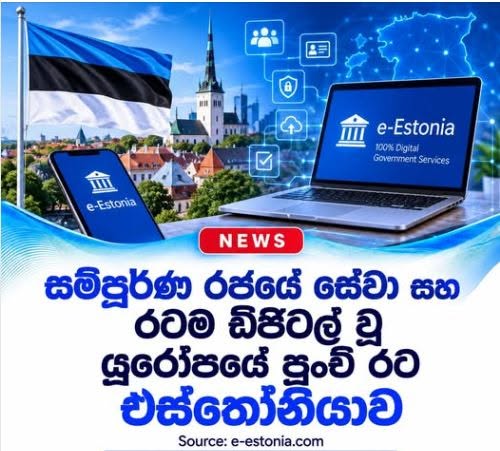
While countries like Singapore, South Korea, and Denmark are global leaders in digitalization, Estonia offers a particularly compelling lesson for Sri Lanka. Like us, Estonia is a small nation. Looking at Estonia’s journey—without any political bias—reveals exactly how the mindset of both current and past leaders needs to change.
Sri Lanka gained independence in 1948, inheriting a strong foundation of railways, tea, and rubber plantations. Estonia, on the other hand, only regained independence from the Soviet Union in 1991. Right from the start, Estonia made a bold decision: to abandon outdated paper-based bureaucracy and build a fully digital state.
Estonia’s Digitalization Timeline
- 1990s: Launched nationwide internet expansion—even across dense forests and snowy landscapes.
- 1997: Accelerated e-Government development.
- 2000: Rolled out Online Tax Declarations and Digital IDs.
- 2001: Introduced X-Road, a secure data exchange layer.
- 2005: Pioneered internet voting (i-Voting) for national elections.
Now look at the contrast. Even in 2026, Sri Lanka is still drowning in paperwork. We still lack a proper Digital ID, our online tax portals barely function, and reliable nationwide internet remains a challenge.
Inside Estonia’s Digital Ecosystem
1. A Digital ID (e-ID) for Every Citizen
Every Estonian citizen receives an e-ID, accessible through three main methods:
- ID Card: A national identity card embedded with a secure chip.
- Mobile-ID: Identity verification and digital signing via mobile phone.
- Smart-ID: A smartphone app for secure logins and digital signatures.
With this, citizens can handle banking, access government services, and sign legal contracts entirely online. Crucially, an Estonian digital signature carries the exact same legal weight as a handwritten one.
2. X-Road: The Backbone of Digital Governance
Estonia’s greatest technical achievement is X-Road (X-tee), a distributed data exchange platform that securely connects government agencies and private-sector systems.
For example, when you visit a public hospital in Estonia, the doctor can immediately access your relevant medical history without you carrying physical files or repeating your details. X-Road operates on the Once-Only Principle: government agencies are not allowed to repeatedly ask citizens for the same information if it already exists legally within another state database. Importantly, X-Road does not centralize all data on a single server; instead, each institution keeps its own data and connects securely.
Compare this to Sri Lanka, where citizens fill out paper forms at the Divisional Secretariat (AG Office), carry another stack of papers to the Pradeshiya Sabha, wait in long queues, and sometimes leave empty-handed because the responsible officer is on leave.
Think this is too difficult or expensive for Sri Lanka? X-Road is open-source. Any country can adopt and customize it—countries like Finland and Iceland already use parts of it—saving massive amounts of time and development costs.
3. 100% Online Public Services
Estonia’s public administration is completely digital:
- Online Tax Filing: No office visits; taxes are filed in minutes via an online portal.
- Digital Healthcare: Medical records, prescriptions, and health data are managed digitally.
- Online Business Registration: Registering a new company takes a maximum of two days online.
- Digital Education: Student records, school administration, and learning platforms are fully digitized.
- Digital Documents: Citizens request, submit, and sign official documents from home.
4. e-Residency: Generating Revenue Globally
Estonia’s e-Residency program is a brilliant economic engine. Anyone in the world—including someone living in Sri Lanka—can register and run a European Union-based company in Estonia completely online in just two days.
To date, Estonia has over 142,000 e-Residents who have launched 43,000+ companies. While Sri Lanka drives away investors with red tape and endless bureaucracy, Estonia provides a seamless digital platform, collects corporate taxes from global entrepreneurs without needing to build them roads or provide local subsidies, and reinvests that revenue into its own citizens.
5. Cybersecurity and the "Data Embassy"
Because all citizen and e-Resident data is online, Estonia enforces strict security protocols:
- Data Encryption for secure communication.
- Digital Signatures to verify document authenticity.
- Access Control restricting data strictly to authorized personnel.
- Audit Logs recording exactly who accessed what data and when.
- Data Integrity checks to detect unauthorized tampering.
In 2017, Estonia also pioneered the Data Embassy concept through an agreement with Luxembourg, backing up critical state data in a secure foreign data center. Even if Estonia’s physical infrastructure were ever destroyed, the country’s digital services could be restored immediately. There is no risk of vital records being eaten by termites, covered in dust, or destroyed by floods in government filing cabinets.
6. Online Voting (i-Voting)
Estonia became the first country to implement internet voting for national elections in 2005, allowing citizens to vote from home or abroad. In the 2023 Parliamentary Elections, 51.1% of votes were cast online, followed by 45.8% in the 2025 Local Government Elections. As a security measure against coercion, voters are allowed to change their online vote during the voting period.
Tech Giants Born in Estonia
Estonia’s digital-first culture didn't just improve governance—it sparked a world-class tech ecosystem that produced global brands:
- Skype: The pioneering voice and video calling platform, whose core software was engineered in Estonia.
- Bolt: The international ride-hailing, food delivery, and e-scooter app.
- Wise: The global FinTech platform for international money transfers and multi-currency accounts.
- Pipedrive: A leading CRM and sales pipeline management tool used worldwide.
- Veriff: An AI-powered online identity verification and KYC platform.
Why Is Sri Lanka Still Stuck in the Past?
Look at the struggle Sri Lankans face just to obtain a TIN number. Our government websites suffer from poor performance, outdated UI/UX, and a lack of basic security.
Many argue that Sri Lanka lacks the money to modernize. That is simply not true. Estonia built these foundations in the 1990s; in 2026, with modern AI tools, building efficient digital systems is faster and cheaper than ever.
The real barrier is our mindset. Since 1948, we have remained trapped in the same outdated thinking patterns—resistant to innovation, new ideas, and bold decision-making. Parliament and top government positions lack qualified, forward-thinking leaders, and public institutions fail to recruit skilled tech talent.
Even recent national budgets follow the same old script: big talk about "AI hubs" and towers, while allocating minimal funding to actual Research & Development (R&D). Millions are still spent on poorly built government websites and systems that deliver dismal results. Unless we empower people who actually understand modern technology to lead the change, we risk being left behind in the Stone Age while the rest of the world moves forward.